RCS messaging : scénariser le parcours

RCS messaging : pourquoi la scénarisation fait toute la différence
Cette semaine, vous avez peut-être reçu un SMS marketing qui ressemblait à ça :
LA CABANE
-20% sur notre collection de taies d'oreillers jusqu'au 15 mai.
Pour en profiter RDV en boutique ou sur notre site internet : [LIEN]
Outre le fait que vous n'avez pas forcément besoin de taies d'oreillers, ce texte est totalement générique. Comme la majorité des milliers d'autres personnes l'ayant reçu, il vous aura soit agacé, et vous l'aurez effacé, soit vous l'aurez lu puis oublié en quelques secondes.
C'est ce qu'on appelle le marketing de masse. Le one-to-many. Il s'adresse à tous et à personne à la fois. Et qui aime être perdu dans la masse ?
Le SMS de La Cabane touche 50 000 personnes. Le RCS parle à chacune d'elles.
1 - Le RCS, c'est quoi exactement ?
Le RCS — Rich Communication Services — enrichit le SMS classique pour permettre plus d'interaction : images, boutons, carrousels, messages personnalisés. Tout ça directement dans l'appli Messages native du téléphone, sans aucun téléchargement.
En France, les quatre opérateurs , Orange, SFR, Bouygues et Free, sont compatibles RCS. Et depuis iOS 18, Apple l'a intégré nativement sur iPhone. Le canal est désormais accessible à l'ensemble du parc smartphone français.
Ce que le RCS permet d'envoyer, contrairement au SMS limité à 160 caractères :
Messages de marque vérifiés : logo, nom, couleurs affichés à la réception
Rich medias : images, vidéos, GIFs, fichiers audios
Carrousels interactifs : plusieurs produits ou offres dans un seul message
Boutons d'action : Appeler, Acheter, Prendre RDV, Répondre
Formulaires de réponse intégrés
Accusés de lecture et de livraison
Résultat : un taux de lecture moyen de 63,7% et un taux de clic 5x supérieur au SMS. Ce ne sont pas des chiffres donnés au hasard, c'est ce qu'on observe sur nos campagnes.
Découvrez notre offre Messaging 2.0 pour en savoir plus
2 - La scénarisation de campagne RCS : ce qui change vraiment tout
La plupart des acteurs qui parlent du RCS s'arrêtent aux fonctionnalités. C'est une erreur.
Un RCS sans scénarisation, ce n’est rien de plus qu’un beau SMS. Avec, c'est une conversation. La différence tient à quatre choses :
l'ordre,
le message,
le moment,
l'audience.
RCS et scénarisation : transformer une campagne en créateur de lien
Imaginez un dîner avec un ami. Il vous parle, puis vous pose une question. Vous lui répondez. Mais il n'écoute pas. Il continue son monologue, comme si votre réponse n'avait jamais existé. Frustrant, non ?
C'est exactement ce que vivent vos clients quand une marque leur permet de répondre via RCS, mais ne tient aucun compte de cette réponse. Le RCS permet au client de s'exprimer. Il faut donc l'écouter et adapter la suite en conséquence.
Ce n'est plus du one-to-many. C'est du one-to-one. On sort de la masse. Le client se sent exister. Votre marque existe auprès du client.
Campagne RCS scénarisée : La Cabane en 3 messages
Même marque, même promo, même base clients. Tout change dans la façon d'adresser le message.
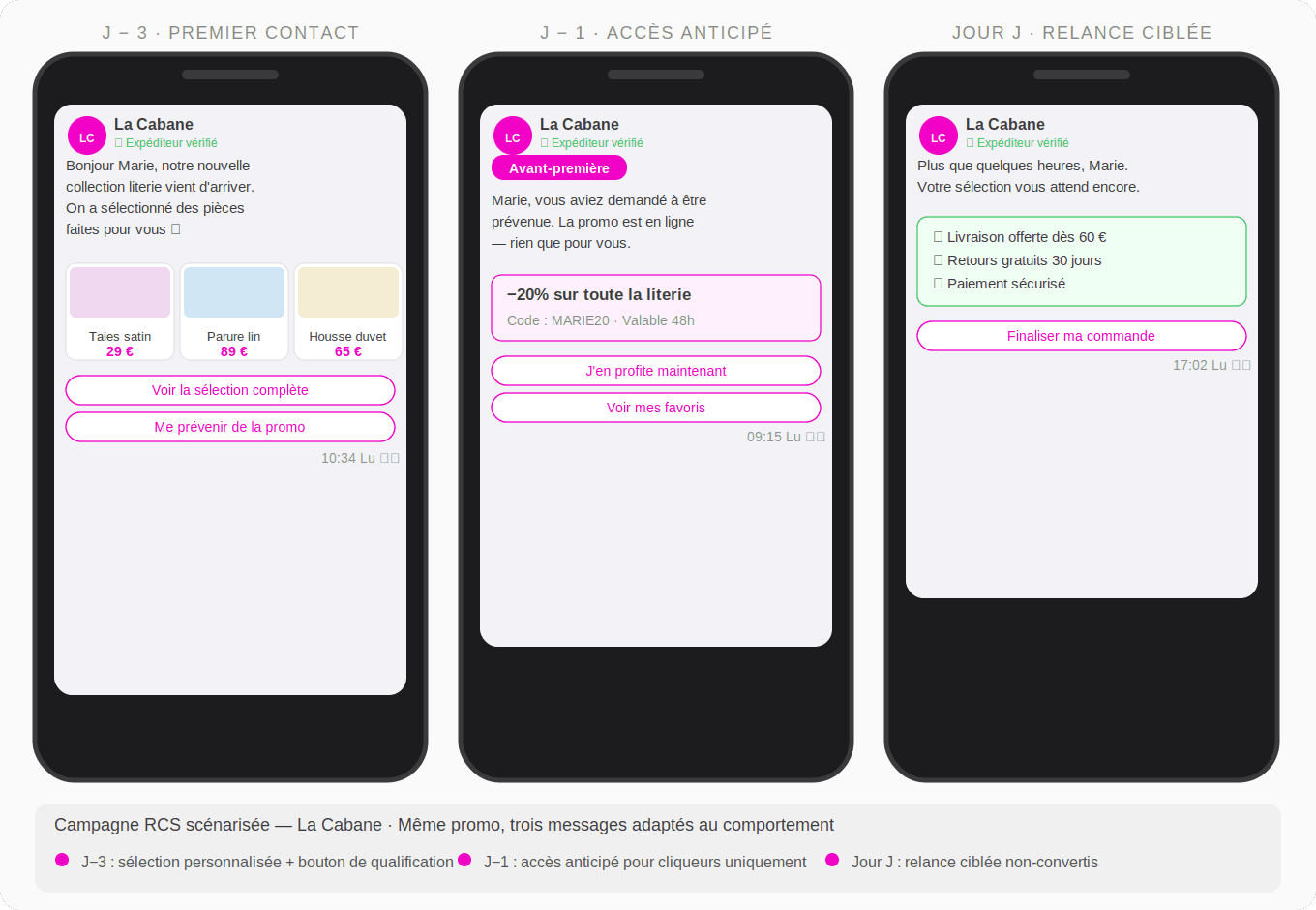
Trois messages. Trois moments. Trois audiences différentes — selon ce que chaque client a fait ou n'a pas fait. C'est ça, la scénarisation de campagne RCS.
3. Et si Plusmo Engage faisait une campagne RCS scénarisée à ses propres prospects ?
On prêche ce qu'on pratique. Voilà ce que donnerait une campagne RCS scénarisée si Plusmo Engage l'envoyait à ses propres prospects.
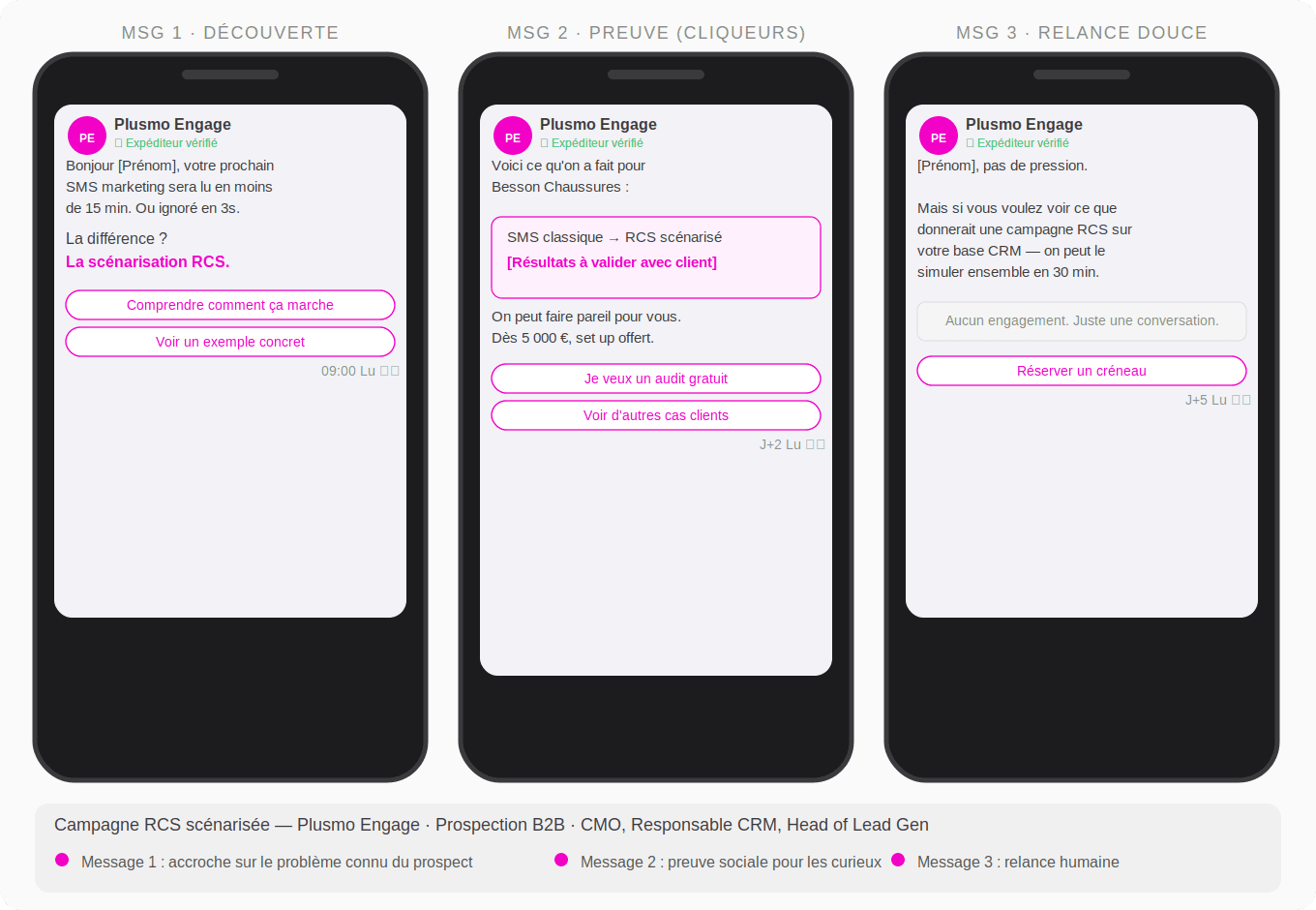
Chaque message répond à ce que le prospect a fait ou n'a pas fait. C'est la même logique que La Cabane, appliquée à la prospection B2B.
4. Comment Plusmo Engage construit une campagne RCS
Notre approche est celle d'une agence, pas d'un SaaS.
Un outil en self-service vous permettra d'envoyer des messages RCS. Mais Il ne regarde pas votre CRM pour identifier vos meilleurs segments. Il ne conçoit pas l'arborescence de scénarios selon ce que chaque client a fait ou pas.
Chez Plusmo Engage, on s'assoit avec vous pour comprendre vos clients, vos objectifs et ce qui coince. On construit la stratégie ensemble et on reste dans la boucle
Les 4 étapes d'une campagne RCS scénarisée
Audit de votre base CRM
Qui sont vos audiences ? Quels segments ? Quels comportements d'achat ?
Conception des scénarios de conversation
Quels messages, dans quel ordre, pour quels déclencheurs ? On construit l'arborescence avec vous.
Déploiement et test A/B
On commence toujours par des segments réduits pour valider avant de scaler.
Analyse et optimisation continue
Chaque campagne alimente la suivante. Les learnings s'accumulent. Les performances progressent.
Premier test possible dès 5 000 €, frais de set up offerts. L'idée : prouver la valeur avant d'aller plus loin.
Vous voulez voir ce que donnerait une campagne RCS scénarisée pour votre marque ?
En résumé
On a construit Plusmo Engage autour de trois mots : conversation, interaction, engagement. Le RCS scénarisé est l'un des leviers les plus performants pour accompagner cette vision du marketing.
Le RCS marketing est une technologie. La scénarisation est une méthode. C'est la combinaison des deux qui produit des résultats.
Les marques qui vont gagner sont celles qui vont apprendre à parler à chaque client, au bon moment, avec le bon message, sur le bon canal. Le RCS, bien utilisé, permet enfin de revenir à quelque chose d’essentiel pour nous autres être humain : créer du lien.